Country
Profile - Gambia
|
General
Information:
Area:
11,295 sq km (4361 sq miles).
Population:
1,303,000 (official estimate 2000).
Population
Density: 115.4 per sq km.
Capital:
Banjul. Population: 42,326 (1993).
GEOGRAPHY:
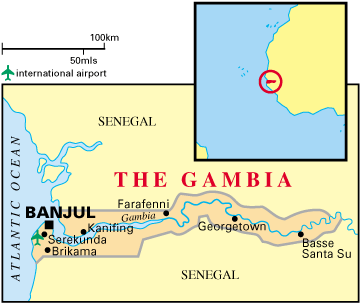
The Gambia is situated on the Atlantic coast at the bulge of Africa. The country
consists of a thin ribbon of land, at no point wider than 50km (30 miles),
running east–west on both banks of the River Gambia. The Gambia is bordered to
the west by the Atlantic Ocean and on all other sides by Senegal. It is also the
smallest and westernmost African nation. The country mainly consists of a low
plateau, which decreases in height as it nears the Atlantic coast. The plain is
broken in a few places by low flat-topped hills and by the river and its
tributaries. The area extending from MacCarthy Island, where Georgetown is
located, to the eastern end of the country, is enclosed by low rocky hills. The
coast and river banks are backed mainly by mangrove swamps, while the lower part
of the river has steep red ironstone banks which are covered with tropical
forest and bamboo. Away from the river, the landscape consists of wooded,
park-like savannah, with large areas covered by a variety of trees such as
mahogany, rosewood, oil palm and rubber. On the coast, the river meets the
Atlantic with impressive sand cliffs and 50km (30 miles) of broad, unspoiled
beaches, palm-fringed and strewn with shells. |
 |
Government:
Republic. Gained independence from the UK in 1965.
Head of State and Government: President Yayah Jammeh since 1994.
Language:
The official language is English. Local languages are Fula, Jola, Mandinka,
Serahule and Wolof.
Religion:
Over 80 per cent Muslim, with the remainder holding either Christian or Animist
beliefs.
Time:
GMT.
Electricity:
220 volts AC, 50Hz. Plugs are either round three-pin or square three-pin (15 or
13 amps).
Communications:
Telephone: IDD is
available. Country code: 220. Outgoing international code: 00. The
country has an automatic telephone system.
Mobile telephone: There
are nine GAMTEL offices in Banjul offering this service, some on a 24-hour
basis.
Fax: There are nine
GAMTEL offices in Banjul offering this service, some on a 24-hour basis.
Internet: Main ISPs
include GAMTEL (website: www.gamtel.gm) and Quantumnet (website: www.qanet.gm).
E-mail can be accessed in Internet cafes in major towns.
Telegram: Services are
run by GAMTEL, Cameron Street, Banjul.
Post: Post office hours: Mon-Fri 0800-1300 and 1400-1700, Sat 0800-1100.
Press: Newspapers are
English-language and include The Daily Observer, The Gambia Daily, The Gambian
and The Independent.
Radio: BBC World Service
(website: www.bbc.co.uk/worldservice) and Voice of America (website: www.voa.gov)
can be received. From time to time the frequencies change and the most
up-to-date can be found online.
Passport/Visa
| |
Passport Required? |
Visa
Required? |
Return
Ticket Required? |
|
British |
Yes |
Yes |
Yes |
|
Australian |
Yes |
Yes |
Yes |
|
Canadian |
Yes |
Yes* |
Yes |
|
USA |
Yes |
Yes* |
Yes |
| OtherEU |
Yes |
No* |
Yes |
|
Japanese |
Yes |
Yes* |
Yes |
PASSPORTS: Passport
valid for at least 3 months after date of return required by all.
VISAS: Required by all
except the following for a maximum stay of 3 months:
(a) nationals of countries
referred to in the chart above (except 1. nationals of Austria, Canada, France,
Japan, Portugal, Spain and the USA who do need a visa);
(b) nationals of Benin,
Botswana, Burkina Faso, Cape Verde, Côte d’Ivoire, Ghana, Guinea, Guinea-Bissau,
Iceland, India, Jamaica, Kenya, Lebanon*, Liberia*, Malawi, Mali, Mauritania,
New Zealand, Niger, Nigeria, Norway, San Marino, Senegal, Sierra Leone*,
Tanzania, Togo, Tunisia, Turkey, Uganda and Zambia;
(c) transit passengers
continuing their journey by the same or first connecting aircraft within 2 hours
provided holding valid onward or return documentation and not leaving the
airport.
Note: (a)* These
nationals do not require a visa, but do require clearance from the Embassy/High
Commission. (b) Nationals of some countries always require a transit visa;
enquire with airline for details. (c) All visitors must hold return or onward
tickets, all documents for their next destination and sufficient funds for their
stay.
Types of visa and cost: Tourist
and Business: £20 (single-entry); £40 (multiple-entry).
Validity: Single-entry
visas are valid for 6 months. Multiple-entry visas are valid for 12 months.
Extensions are possible and should be applied for at the Immigration Office in
The Gambia.
Application to:
Consulate (or Consular section at Embassy); see Contact Addresses section.
Application requirements:
(a) Valid passport. (b) One application form. (c) One passport-size photo. (d)
Fee, payable in cash, cheque or postal order only. (e) Stamped, self-addressed
envelope (by registered post) or £3.50 for postal applications. (f) For business
trips, a letter of invitation from the company in The Gambia or a letter from
the applicant’s employer explaining the purpose of the visit.
Working days required:
48 hours in person. At least 1 week by post.
Temporary residence:
Enquiries should be referred to The Gambian Embassy, High Commission or
Consulate (see Contact Addresses section).
Money
Currency: Gambian Dalasi
(D) = 100 bututs. Notes are in denominations of D50, 25, 10 and 5. Coins are in
denominations of D1, and 50, 25, 10, 5 and 1 bututs.
Currency exchange: There
is a bank/bureau de change (Meridien Bank) at the airport operating during
scheduled flights. The capital, Banjul, also has a number of banks where foreign
currencies can be exchanged. Some hotels and tourist resorts also offer foreign
exchange facilities, but tend to charge high commissions. ATMs are available in
large urban areas.
Credit & debit cards:
American Express, MasterCard and Visa are accepted in most hotels if arranged at
the beginning of the stay. Check with your credit or debit card company for
details of merchant acceptability and other services which may be available.
Travellers cheques: To
avoid additional exchange rate charges, travellers are advised to take
travellers cheques in Pounds Sterling or US Dollars.
Exchange rate indicators:
The following figures are included as a guide to the movements of the Dalasi
against Sterling and the US Dollar:
|
Date |
Nov'03 |
Feb'04 |
May'04 |
Aug'04 |
|
£1.00 |
45.45 |
53.87 |
54.15 |
52.24 |
|
$1.00 |
28.49 |
31.75 |
29.75 |
29.25 |
Currency restrictions:
The thriving black market for hard currency is officially discouraged, and
visitors must complete a currency declaration form on arrival. Currency from
Algeria, Ghana, Guinea, Mali, Morocco, Nigeria, Sierra Leone and Tunisia is
neither accepted nor exchanged. There are no restrictions on the import of local
or other foreign currencies. Export of local or other foreign currencies is up
to the amount imported. CFA Francs are accepted. Local currency may be difficult
to exchange outside the country but there are no restrictions on its import and
export.
Banking hours: Mon-Thurs
0800-1330, Fri 0800-1100. Some banks open on Saturday and opening hours may vary
from place to place.
Duty Free
Duty Free: The following
goods may be imported into The Gambia without incurring customs duty:
200 cigarettes or 50 cigars or
250g of tobacco (or mixed to the same total weight); 750ml of spirits; 1500ml of
beer or wine; 284ml of perfume or toilet water; goods up to a value of D1000
(members of families travelling together may aggregate their individual
allowances provided no single article exceeds D1000 in value).
Public Holidays
Public Holidays: Jan 1
2004 New Year’s Day. Feb 2 Tabaski (Feast of the Sacrifice). Feb 18 Independence
Day. Apr 9 Good Friday. Apr 12 Easter Monday. May 1 Labour Day. May 2 Milad al-Nabi
(Birth of the Prophet). Jul 22 Revolution Day. Aug 15 Assumption. Nov 14-16
Koriteh (End of Ramadan). Dec 25 Christmas. Jan 1 2005 New Year’s Day. Jan 21
Tabaski (Feast of the Sacrifice). Feb 18 Independence Day. Mar 25 Good Friday.
Mar 28 Easter Monday. Apr 21 Milad al-Nabi (Birth of the Prophet). May 1 Labour
Day. Jul 22 Revolution Day. Aug 15 Assumption. Nov 3-5 Koriteh (End of Ramadan).
Dec 25 Christmas.
Note: Muslim festivals
are timed according to local sightings of various phases of the moon and the
dates given above are approximations. During the lunar month of Ramadan that
precedes Koriteh, Muslims fast during the day and feast at night and normal
business patterns may be interrupted. Many restaurants are closed during the day
and there are restrictions on smoking and drinking. Some disruption may continue
into Koriteh itself. Koriteh and Tabaski may last anything from 2 to 10 days,
depending on the region. For more information, see the World of Islam appendix.
Health
| |
Special Precautions |
Certificate Required? |
|
Yellow Fever |
Yes |
1 |
|
Cholera |
Yes |
2 |
|
Typhoid and Polio |
3 |
N/A |
|
Malaria |
4 |
N/A |
1: A yellow fever vaccination
certificate is required from all travellers over 1 year of age arriving from
endemic or infected areas. Travellers arriving from non-endemic zones should
note that vaccination is strongly recommended for travel outside the urban
areas, even if an outbreak of the disease has not been reported and they would
normally not require a vaccination certificate to enter the country.
2: Following WHO guidelines
issued in 1973, a cholera vaccination certificate is no longer a condition of
entry to The Gambia. However, cholera is a risk in this country and precautions
are necessary. Up-to-date advice should be sought before deciding whether these
precautions should include vaccination as medical opinion is divided over its
effectiveness. See the Health appendix for more information.
3: Immunisation against typhoid
and poliomyelitis is often advised.
4: Malaria risk, predominantly
in the malignant falciparum form, exists all year throughout the country.
Chloroquine resistance has been reported.
Food & drink: All water should
be regarded as being potentially contaminated. Water used for drinking, brushing
teeth or making ice should have first been boiled or otherwise sterilised. Milk
is unpasteurised and should be boiled. Powdered or tinned milk is available and
is advised, but make sure that it is reconstituted with pure water. Avoid dairy
products that are likely to have been made from unboiled milk. Only eat
well-cooked meat and fish, preferably served hot. Pork, salad and mayonnaise may
carry increased risk. Vegetables should be cooked and fruit peeled.
Other risks: Diarrhoeal
diseases, including giardiasis, and typhoid fevers are common. Bilharzia (schistosomiasis)
is present. Avoid swimming and paddling in fresh water; swimming pools that are
well chlorinated and maintained are safe. Hepatitis A and E are widespread.
Hepatitis B is endemic. Epidemics of meningococcal disease may occur throughout
tropical Africa, particularly in the savannah areas and during the dry season.
Immunisation against diphtheria is sometimes recommended.
Rabies is present. For those at
high risk, vaccination before arrival should be considered. If you are bitten,
seek medical advice without delay. For more information, consult the Health
appendix.
Health care: Visitors are
advised to bring good supplies of sunscreen, insect repellent and indigestion/diarrhoea
medicines; all of these may be needed and they can prove expensive or, in some
cases, impossible to buy in The Gambia. The Government provides both therapeutic
and preventative medical and health services, and plays a dominant role in
health services. Health insurance is strongly advised.
Travel – International
AIR: The main airlines
to serve The Gambia are Air Senegal, Ghana Airways and Nigeria Airways. There
are also many charter services.
Approximate flight times:
From Banjul to London is approximately 5 hours 30 minutes (direct).
International airports:
Banjul (BJL) (Yundum International) is 20km (11 miles) southwest of the city.
Taxis are available to the city (travel time – approximately 30 minutes). During
1989, NASA upgraded airport facilities to enable it to serve as an emergency
space-shuttle landing site. Airport facilities include banks/bureaux de change,
bars, restaurants, duty-free shops, post office and car hire (Hertz).
Departure tax: None.
Tourist tax: A tourist
tax applies for all tourists arriving at Banjul International Airport, no matter
from which country. Travellers can pay in Euros (€10), Sterling (£5) or US
Dollars (US$10).
RIVER: Ferries operate
services between Banjul and Dakar or Ziguinchor (Senegal). This tends to be a
more efficient form of travel than overland.
ROAD: Taxis can be hired
between Dakar (Senegal) and Barra. Buses also travel between Senegal and The
Gambia.
Travel – Internal
Note: Visitors should not
travel by road from The Gambia to Casamance in southern Senegal because of the
risk of armed banditry. Crime against tourists is rare, but sensible precautions
must be taken and vigilant maintained. Care should be taken when driving or
walking on roads, particularly at night, due to unpredictable driving standards
and lack of street lighting.
RIVER: There are no
longer any scheduled services along the River Gambia, although private charters
are available.
ROAD: Traffic drives on
the right. There are 2700km (1675 miles) of roads in the country, about 32 per
cent of which are paved. Roads in and around Banjul are mostly bituminised, but
unsealed roads often become impassable in the rainy season. Road construction
programmes include the new link from Banjul to Serrekunda and the proposed link
from Lamin Koto to Passimas. The Trans-Gambia Highway and Kombo coastal roads
are being upgraded. Bus: Local buses operate between Banjul and a number of
towns and villages throughout the country. The services are fairly reliable, but
buses tend to be overcrowded. Taxis: These are available outside main hotels.
City taxis are usually painted yellow and tourist taxis painted green; the
latter can be hired to go anywhere in the country. It is advisable to settle
taxi fares in advance. Car hire: This is possible; check with the car hire
company for details before travelling. Documentation: An International Driving
Permit will be accepted for a period of 3 months. A temporary licence is
available from the local authorities on presentation of a valid UK licence.
Accommodation
ACCOMMODATION: By
African standards, The Gambia has a fairly developed tourist industry, with many
hotels geared primarily to package tours. During the tourist season (November to
May), accommodation is often booked up and confirmation of advance booking is
advised. Most of the hotels are self-contained complexes offering a wealth of
tourist facilities including swimming pools, bars, restaurants, shops, sporting
facilities and spacious gardens. Bedrooms will not always be air conditioned.
The number of hotels has increased greatly in recent years and this is expected
to continue; today there are over 24 hotels with 6000 beds, both in Banjul and
along the coast. Around 75 per cent of establishments belong to The Gambia Hotel
Association, which can be contacted c/o PO Box 2637, The Bungalow Beach Hotel,
Serrekunda, Kotu (tel: 465 288; fax: 466 180; e-mail: bbhotel@qanet.gm). For
further information on different types of accommodation, contact The Gambia
National Tourist Office (see Contact Addresses section).
Sport & Activities
Watersports: Atlantic
resorts cater for waterskiing, windsurfing and surfing. Sailing is possible at
The Gambia Sailing Club at Banjul, which welcomes visitors. A notable event is
the race to Dog Island. Additional regattas are organised on special occasions.
Both sea and river fishing is good all year, particularly line-fishing from the
beaches. Several sport-fishing boats are available for sea-angling trips. The
estuary of the River Gambia on the Atlantic coast provides miles of magnificent
beaches with warm seas throughout the year for swimming. Caution is necessary,
owing to strong currents, but the beach at Cape St Mary is safe for both
children and adults.
Spectator sports: The
Banjul Golf Club has an 18-hole golf course at Fajara near the Atlantic coast.
International meetings are organised every year. Wrestling is the traditional
national sport; contests can be watched in most towns and villages. Bouts (a
traditional sport) can be seen on most weekends in Banjul and its suburbs,
Serekunda and Bakau. Inter-club cricket is played in league matches organised by
The Gambia Cricket Association, which also organises international matches. A
league football championship is organised by the Gambia Football Association.
Birdwatching: This is
very popular and the country has one of the largest concentrations of bird
species per square mile in the world.
Social Profile
Food & Drink: Western
food is available at most tourist hotels and restaurants, and some also serve
Gambian food. Recommended dishes include benachin (also called ‘Jollof Rice’, a
mixture of spiced meat and rice with tomato puree and vegetables), base nyebe
(rich stew of chicken or beef with green beans and other vegetables), chere
(steamed millet flour balls), domodah (meat stewed in groundnut puree and served
with rice), plasas (meat and smoked fish cooked in palm oil with green
vegetables) served with fu-fu or mashed cassava chura-gertek (a sweet porridge
consisting of pounded groundnuts, rice and milk). Local fruits like mangoes,
bananas, grapefruit, papayas and oranges are delicious and are available in the
markets.
A good selection of spirits,
beers and wines is available. Jul Brew is the local speciality beer. Local fresh
fruit juice is delicious.
Nightlife: In general
the nightlife is subdued, although there are nightclubs in Bakau, Banjul,
Farjara and Serrekunda. There are organised performances of Gambian ballet,
drumming and dancing, and also fire-eating displays.
Shopping: Souvenirs can
be bought in Banjul at the craft market across from MacCarthy Square and at
bengdulalu (see Resorts & Excursions section). One of the most popular purchases
is the Gambishirt, made of printed and embroidered cotton cloth, mostly in
bright colours. Some of the souvenirs are gaudy, others exceedingly attractive.
Woodcarvings, beaded belts, silver and gold jewellery and ladies’ handbags are
also popular items. Other West African handicrafts made of straw, beads,
leather, cloth or metal can be purchased here. Shopping hours: Mon-Thurs
0900-1200 and 1430-1800, Fri-Sat 0900-1300. Some shops may stay open until 2200.
Special Events: Dance or
acrobatic street shows can be seen at any time of the year; for further details,
enquire at The Gambia National Tourist Office (see Contact Addresses section).
The following is a selection of special events celebrated annually in The
Gambia:
Feb Tabaski (Feast of the Sacrifice); Ras-as-Sana (Islamic New Year). Apr Grand
Magal. Jun-Jul International Roots Festival (a celebration aimed at getting
Americans and Europeans of African descent back in touch with Africa). Oct-Nov
Ramadan. Nov Koriteh (end of Ramadam). Dec Christmas.
Social Conventions:
Handshaking is a common form of greeting; Nanga def (‘How are you?’) is the
traditional greeting. Gambians are extremely friendly and welcoming and visitors
should not be afraid to accept their hospitality. Many Gambians are Muslim and
their religious customs and beliefs should be respected by guests; however, most
understand the English customs and language. Visitors should remember that the
right hand only should be used for the giving or receiving of food or objects.
Casual wear is suitable although beachwear should only be worn on the beach or
at the poolside. Only the most exclusive dining rooms encourage guests to dress
for dinner. Despite the effects of tourism, traditional culture in music,
dancing and craftsmanship still flourishes in the many villages on both banks of
the River Gambia. Tipping: 10 per cent service charge is sometimes included in
hotel and restaurant bills.
Business Profile
Economy: The economy of
The Gambia is basically agricultural, with groundnuts (in the form of nuts, oil
and cattle cake) accounting for 50 per cent of total exports. Cotton and citrus
fruits are also cultivated for export. Forestry and fishing are also important.
Rice, millet and maize are the main staples, but The Gambia must import large
quantities of rice along with various other foodstuffs and petroleum products.
There are no viable mineral deposits although surveys have located some oil
deposits. The small industrial sector is dominated by agro-industrial
activities; drinks and construction materials are produced for the domestic
market. After a disastrous spell following the 1994 coup, tourism is once again
a viable generator of foreign exchange, and has performed relatively well since
then. Principal markets for exports are Belgium, Luxembourg, Japan and Guinea.
Government economic strategy aims to position The Gambia as a regional hub for
trade, based on an important re-export trade (mostly of Senegalese goods) as
well as finance and telecommunications: the strategy has had mixed success in
the last few years. Overall, the economy has performed well, since 2000,
averaging annual growth of 6 per cent. Substantial infrastructural progress has
been made (such as the construction of schools and hospitals, a new airport
terminal and modernised port facilities). In 1998, the government, unusually,
renationalised the groundnut industry, which had been privatised four years
earlier but performed poorly under private ownership. International aid remains
essential to the health of The Gambia’s economy.
Business: Businessmen
wear jackets and ties for business meetings. A personal approach is important in
Gambian business circles. Punctuality is appreciated and it is advisable to take
business cards, although their use is not widespread. Office hours: Mon-Thurs
0800-1600, Fri 0800-1230.
Commercial Information:
The following organisation can offer advice: The Gambia Chamber of Commerce and
Industry, 1-3 Ecowas Avenue, Banjul (tel: 227 765 or 227 042; fax: 229 671;
e-mail: gcci@qanet.gm; website: www.gambiachamber.gm or www.gcci.gm).
Climate
Climate: The Gambia is
generally recognised to have the most agreeable climate in West Africa. The
weather is subtropical with distinct dry and rainy seasons. From mid-November to
mid-May, coastal areas are dry, while the rainy season lasts from June to
October. Inland the cool season is shorter and daytime temperatures are very
high between March and June. Sunny periods occur on most days even during the
rainy season.
Required clothing:
Lightweight or tropical for most of the year with rainwear for the rainy season.
