
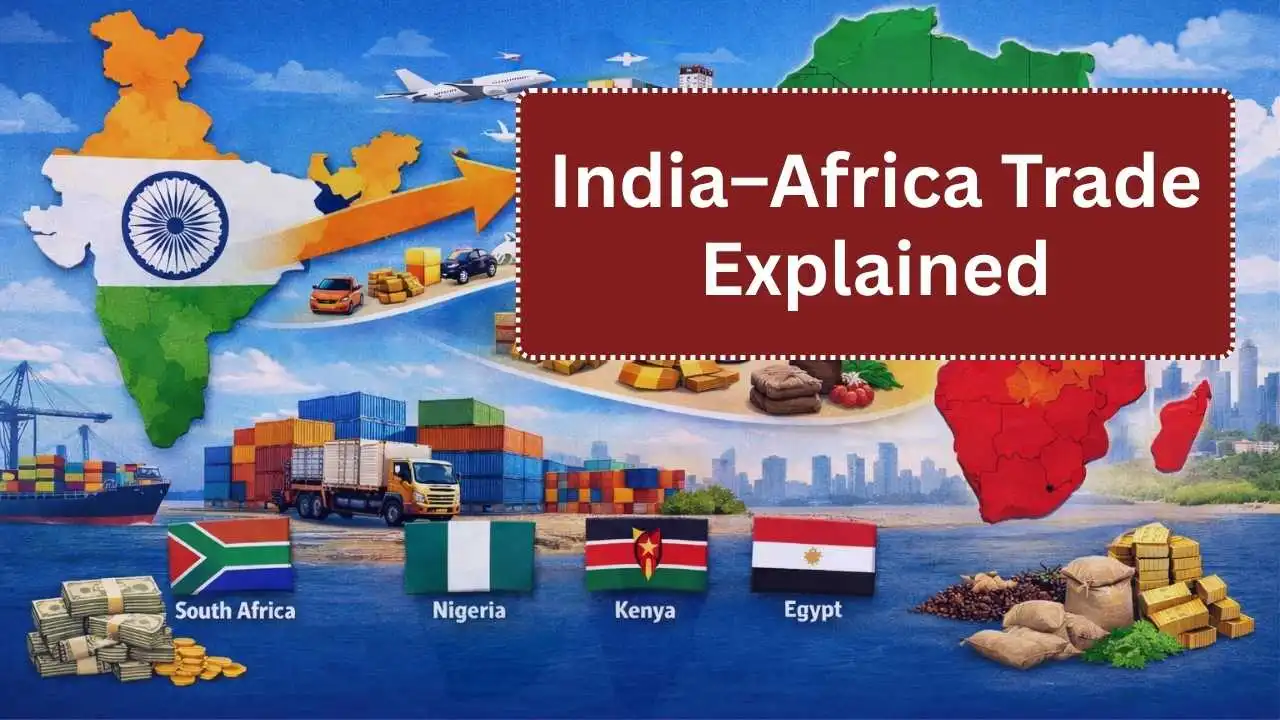
Trade between India and Africa has quietly become one of the most important economic relationships in the Global South. Africa’s population is expected to double by 2050, creating massive demand for affordable medicines, food products, vehicles, construction materials, and energy areas where India has strong competitive advantages. At the same time, India depends heavily on Africa for crude oil, natural gas, coal, gold, fertilizers, and strategic minerals, making the relationship mutually beneficial rather than one-sided.
India–Africa Trade Explained
The scale of trade has expanded rapidly over the last two decades. Annual bilateral trade has grown from under $10 billion in the early 2000s to well over $90 billion in recent years, with ambitions to cross $150 billion in the coming decade. This growth is supported by lines of credit, capacity-building initiatives, private investment, and strong diaspora and business networks.
A senior Indian trade official recently stated, “Africa is not just a destination for Indian exports; it is a long-term strategic economic partner.”
Also Read Key Sectors Powering India–Africa Trade Growth in 2026
India–Africa Trade $100 Billion Milestone – Overview
| Trade Indicator | Latest Snapshot |
|---|---|
| Total Annual Trade | Over $90 billion |
| India’s Exports to Africa | Around $45 to 50 billion |
| Africa’s Exports to India | Around $40 to 45 billion |
| Key Indian Exports | Petroleum products, pharma, vehicles, machinery |
| Key African Exports | Crude oil, coal, gold, fertilizers |
| Top African Partners | Nigeria, South Africa, Egypt, Kenya |
| Trade Balance | Broadly balanced |
| Growth Trend | Long-term upward |
| Strategic Focus | Energy, health, infrastructure |
| Future Outlook | Continued expansion |
How Large Is India–Africa Trade Today?
The Directorate General of Commercial Intelligence & Statistics (DGCI&S) and other official compilations show sustained growth over recent years: trade rose from roughly USD 68–70 billion a decade ago to more than USD 80 billion in 2023–24, and further into the USD 100+ band in 2024–25 driven by diversified trade flows and expanded services and investment links.
India–Africa trade has reached a scale that places India among Africa’s top three trading partners, alongside China and the European Union. The trade relationship is notable not only for its size but also for its balance India imports almost as much from Africa as it exports, unlike some major trading relationships that are heavily skewed. Trade flows are driven by:
- Africa’s energy and mineral resources
- India’s manufacturing and pharmaceutical strength
- Rapid urbanization and infrastructure development in Africa
- Competitive pricing and adaptable supply chains
What India Exports to Africa?
- Petroleum Products and Energy Goods: Refined petroleum products account for a large share of India’s exports to Africa. India imports crude oil from Africa, refines it domestically, and exports refined fuels back to African markets creating a value-added trade loop.
- Pharmaceuticals and Healthcare: India supplies a significant portion of Africa’s generic medicines, vaccines, and medical equipment. Indian pharmaceuticals are widely used in public health systems due to affordability and reliability.
- Automobiles and Machinery: Indian manufacturers export the following –
- Passenger vehicles and two-wheelers
- Commercial trucks and buses
- Agricultural and construction machinery
These exports support Africa’s transport, farming, and infrastructure sectors.
What Africa Exports to India?
- Crude Oil and Natural Gas: Energy dominates Africa’s exports to India. Countries such as Nigeria and Angola are key suppliers, helping India diversify away from Middle Eastern dependence.
- Minerals and Metals: Africa exports the following –
- Gold and precious metals
- Coal and coke
- Copper, phosphates, and manganese
These materials feed India’s manufacturing, power, and fertilizer industries.
- Agricultural Inputs: Fertilizers and raw agricultural materials from Africa support India’s food security and agribusiness sectors.
An energy analyst observed, “Africa plays a growing role in securing India’s long-term resource needs.”
Country-Wise Drivers of Trade Growth
| Nigeria | India is one of Nigeria’s top oil customers, while Nigeria imports pharmaceuticals, vehicles, and refined fuels from India. |
| South Africa | South Africa is a diversified trade partner, exporting gold, coal, and minerals while importing machinery, vehicles, and medicines. |
| Egypt | Egypt serves as a gateway to North Africa and the Middle East, importing Indian textiles, chemicals, and vehicles while exporting fertilizers and chemicals. |
Sectoral Trends Shaping the Future
- Energy Transition: India is increasingly investing in African renewable energy and gas infrastructure, signaling a shift beyond oil-centric trade.
- Manufacturing and Industrialization: Africa’s push for local manufacturing has increased demand for Indian machinery, industrial inputs, and technical expertise.
- Digital and Services Trade: Indian IT, fintech, and telecom firms are expanding across Africa, adding a services dimension to traditional goods trade.
A trade economist stated, “India–Africa trade is moving up the value chain.”
Why India–Africa Trade is Strategically Important?
This trade relationship matters because:
- It reduces dependence on traditional Western markets
- It strengthens South-South economic cooperation
- It supports development goals in African economies
- It enhances India’s global economic influence
The partnership is also supported by long-term credit lines, training programs, and technology transfer—making it more than just transactional trade.
Where is Trade Headed?
Most projections suggest India–Africa trade could exceed $150 billion within the next decade, driven by:
- Population growth
- Infrastructure spending
- Energy diversification
- Healthcare demand
Key Takeaways
- India–Africa trade exceeds $90 billion annually
- Energy, pharma, vehicles, and minerals dominate trade
- Nigeria, South Africa, and Egypt lead partnerships
- Trade is balanced and diversified
- Long-term growth prospects remain strong
FAQs
How big is India–Africa trade today?
It exceeds $90 billion annually and continues to grow.
What does India export most to Africa?
Petroleum products, pharmaceuticals, vehicles, and machinery.
What does Africa export most to India?
Crude oil, minerals, coal, and gold.
Which African country trades most with India?
Nigeria is the largest trading partner.
Is India–Africa trade expected to grow further?
Yes, long-term trends point to significant expansion.