
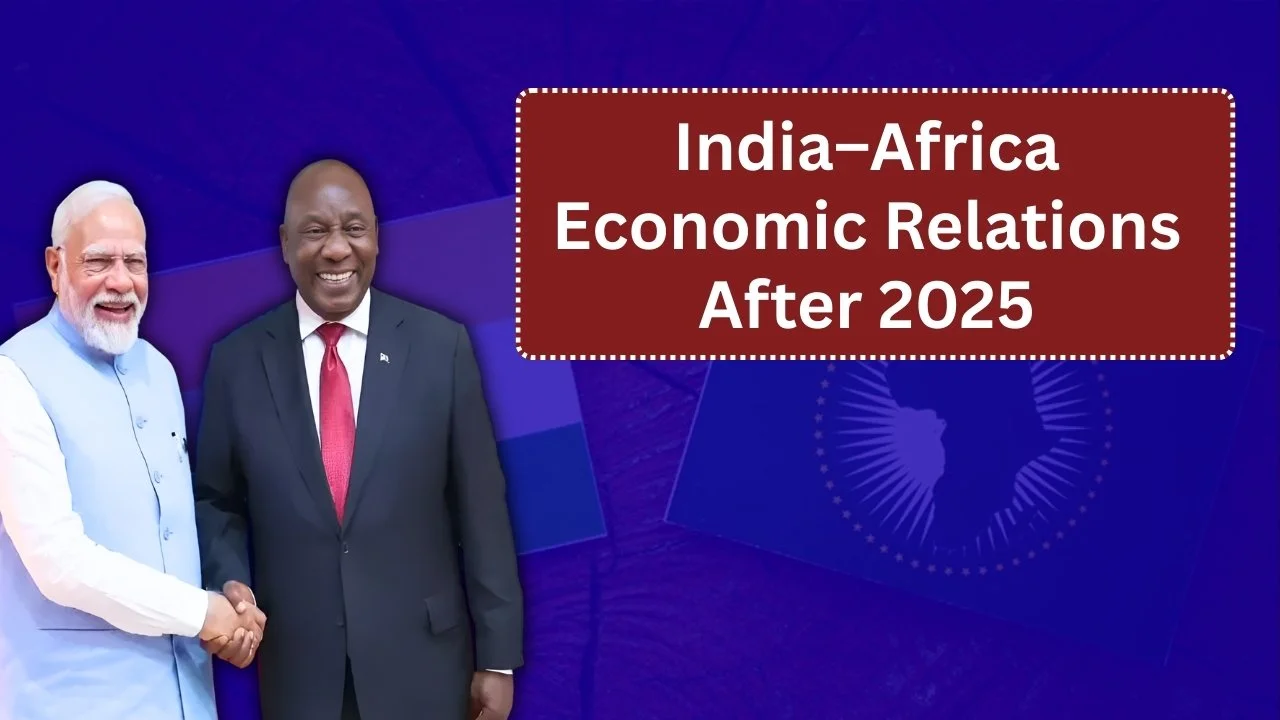
India–Africa economic relations entered a new phase after 2025, marked by deeper trade integration, more structured investment flows, and a sharper strategic focus on long-term development rather than short-term commerce.
By 2025, Africa had already emerged as one of India’s most important global partners, accounting for a significant share of India’s exports in pharmaceuticals, refined petroleum products, vehicles, machinery, textiles, and digital services.
What changed after 2025 was scale, structure, and intent. Trade volumes expanded, but more importantly, the composition of trade diversified. India began exporting higher-value manufactured goods and services, while African nations increased exports of critical minerals, agricultural commodities, and energy products.
India–Africa Economic Relations in the Post-2025 Era: Overview
| Trade Volume | Strong growth with diversified exports |
| Trade Composition | Shift toward value-added goods |
| Investment | More manufacturing and infrastructure FDI |
| Policy Frameworks | Structured bilateral and regional agreements |
| Energy Trade | Expansion in fuels and renewables |
| Pharmaceuticals | Africa becomes a top export destination |
| Digital Economy | Growth in fintech and IT services |
| Logistics | Improved shipping and trade corridors |
| Currency Use | More local-currency settlements |
| Strategic Focus | Long-term economic partnership |
How India–Africa Trade Grew Stronger and More Balanced?
After 2025, India–Africa trade volumes continued to rise, but the most notable change was balance and resilience. Previously, trade was heavily concentrated in a few commodities. Post-2025, exports and imports became more diversified. India’s exports increasingly included:
- Finished pharmaceuticals instead of raw inputs
- Commercial vehicles and auto components
- Electrical machinery and power equipment
- Processed food products
Africa’s exports to India expanded beyond crude oil to include:
- Gold and precious metals
- Critical minerals for manufacturing
- Agricultural commodities
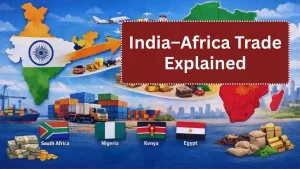
This diversification reduced volatility and strengthened long-term trade sustainability.
An African trade ministry official noted, “The structure of trade matters as much as the size, and India’s exports now align better with Africa’s development priorities.”
Also Read India Export Destinations in Africa: Top African Importers for 2026
Why Manufacturing Became Central to India–Africa Investment Ties?
One of the biggest changes after 2025 was the rise in Indian investment within Africa, particularly in manufacturing and industrial zones. Instead of exporting everything from India, companies increasingly established local production facilities. Key investment areas included:
- Pharmaceutical manufacturing plants
- Automotive assembly units
- Agro-processing facilities
- Renewable energy infrastructure
These investments created jobs locally while giving Indian firms better access to African regional markets. Pharmaceuticals became one of the most strategically important sectors after 2025. India supplied a significant share of Africa’s generic medicines, vaccines, and medical equipment. Post-2025 changes included:
- Technology transfer to African manufacturers
- Local drug production partnerships
- Faster regulatory cooperation
This reduced dependence on distant suppliers and improved healthcare resilience.
Energy and Resources: Beyond Oil
Energy trade evolved significantly after 2025. While crude oil remained important, cooperation expanded into refined fuels, gas infrastructure, and renewable energy. Key developments included:
- Indian investment in African refineries
- Solar and wind energy projects
- Battery and mineral supply chains
Africa’s mineral resources increasingly supported India’s manufacturing and energy transition goals.
Digital Economy and Services Trade
The post-2025 period saw a sharp rise in services trade, especially in technology and digital platforms. Indian IT firms expanded operations in Africa, supporting:
- Digital banking and fintech
- Government digitization
- Telecom infrastructure
- Education technology
This marked a shift from goods-only trade to a knowledge-driven partnership.
A technology official stated, “India’s digital expertise complements Africa’s rapid adoption of mobile-based services.”
Infrastructure and Connectivity Improvements
Logistics improvements were critical after 2025. Trade corridors, port cooperation, and shipping routes became more efficient. Changes included:
- Reduced shipping times
- Better port-to-port coordination
- Increased use of regional hubs
This made Indian goods more competitive and African exports more reliable.
Currency and Payment Innovations
Another major shift was experimentation with local-currency trade settlements, reducing reliance on third-country currencies. Benefits included:
- Lower transaction costs
- Reduced exchange-rate risk
- Faster payment settlements
While still limited in scale, these mechanisms expanded after 2025. Government-level coordination intensified. India and African nations aligned trade policies with development goals, focusing on:
- Skills development
- Industrial capacity building
- SME cooperation
An Indian diplomatic official summarized it as, “Economic cooperation is now linked to long-term growth, not short-term trade gains.”
Why the Post-2025 Shift Matters?
The evolution of India–Africa economic relations after 2025 is more than a shift in trade numbers it reflects a deeper transformation in how two fast-growing regions engage with each other in a changing global economy. As traditional trade partners face geopolitical tensions, supply-chain disruptions, and slowing growth, India and Africa are increasingly looking toward each other for stability, diversification, and long-term opportunity.
For African economies, stronger ties with India mean access to affordable pharmaceuticals, machinery, vehicles, technology, and refined petroleum products all critical for development, healthcare, and industrialization. Indian exports often fill gaps that local production cannot yet meet, while Indian investments support infrastructure, manufacturing, and skills development. This directly impacts employment, public health, and economic resilience across the continent.
For India, Africa represents one of the largest future growth markets in the world, driven by population expansion, urbanization, and rising consumer demand. Deepening economic relations after 2025 helps India secure energy resources, expand export markets, and strengthen its role as a leading voice in Global South cooperation. It also allows Indian companies to diversify supply chains away from over-concentrated regions.
On a broader level, the post-2025 shift signals a move toward more balanced, South–South economic partnerships. Instead of relationships based purely on raw materials and finished goods, India–Africa ties are increasingly centered on joint ventures, technology transfer, capacity building, and long-term development goals. This rebalancing supports sustainable growth rather than short-term trade gains.
Ultimately, these changes matter because they shape future economic independence for both regions. As global trade becomes more fragmented, India–Africa cooperation offers a practical model of mutual growth built on shared challenges, complementary strengths, and a strategic vision that extends well beyond 2025.
FAQs
Did India–Africa trade increase after 2025?
Yes, both volume and diversity increased.
What sectors grew the most after 2025?
Pharmaceuticals, manufacturing, energy, and digital services.
Did Indian companies invest more in Africa?
Yes, especially in manufacturing and infrastructure.
Is Africa important to India’s supply chains?
Increasingly, particularly for minerals and energy.
Is this partnership long-term?
Yes, it is now structured for sustained growth.